


 Web Design
 Web Development
 UX/UI Design
 eCommerce Websites
 WordPress Web Design
 WooCommerce Web Design
 Shopify Web Design
 eCommerce Integrations
 Landing Page Design
 Corporate Web Design
 Website Redesign Services
 Responsive Web Design
 Website Maintenance
 SEO Services
 AI SEO
 Local SEO
 Content Marketing
 Digital PR
 Technical SEO
 Small Business SEO
 Google Adwords
 Google Remarketing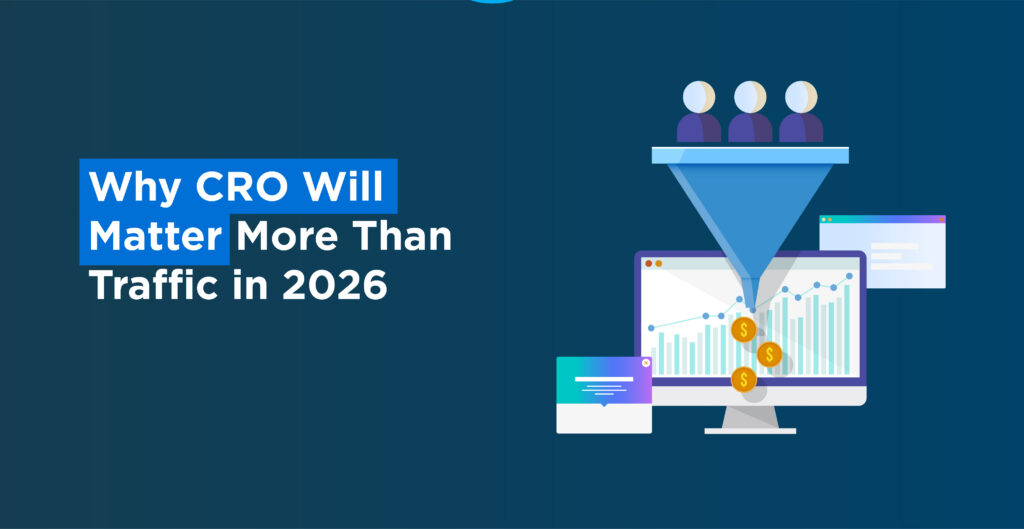
There has long been an assumption that more website traffic automatically leads to business growth. More visitors should mean more enquiries and sales. In 2026, that thinking is becoming less reliable.
Rising advertising costs, increasing competition, AI-driven search experiences, and changing user behaviour mean that traffic alone is no longer enough. Businesses that convert more of their existing visitors will often outperform competitors generating significantly more traffic.
This is where conversion rate optimisation (CRO) becomes critical.
Conversion rate optimisation (CRO) is the missing link between traffic and commercial results. If a website doesn’t turn visitors into leads, bookings, or purchases, then more traffic simply pours more people into a funnel that already leaks. Let’s break down why CRO will matter more than traffic this year and how businesses can respond in a practical way.
Why Traffic Alone Is Becoming Less Reliable
Traffic still matters, of course, but it’s no longer a dependable growth strategy on its own. Search results are more competitive, paid media requires sharper budget control, and users have more choice than ever before they decide to engage.
Your business might attract steady visitors through SEO, Google Ads, or content marketing. But if your landing page doesn’t match intent or build trust, they may leave without taking action.
Traffic Costs More to Earn and Buy
Both organic and paid channels now demand more effort to perform well. SEO requires consistent content quality, technical strength, and ongoing optimisation to maintain visibility in competitive markets. Meanwhile, paid channels like Google Ads need tighter optimisation to make sure every click is justified by a strong return.
The key issue isn’t just cost but also efficiency. Every unconverted visitor represents wasted opportunity. CRO helps reduce that waste by improving how effectively your existing traffic turns into leads or sales.
AI Search Can Reduce Click Opportunities
Search behaviour is also evolving. AI-generated answers and richer search results can sometimes reduce the number of clicks needed for simple queries. Users may get basic information directly on the results page before they ever visit a website.
That doesn’t remove the need for traffic. But, it boils down to making every visit count. If there are fewer clicks, the quality of visits becomes even more important. Businesses that convert well will naturally gain more value from the traffic they receive.
AI-Driven Traffic May Be Lower but More Qualified
As AI-powered search experiences continue to evolve, users arriving on websites may have already completed much of their initial research. Instead of comparing multiple providers from scratch, they often arrive with a clearer understanding of their needs and a shorter list of potential options.
This means website visitors can be more informed and closer to making a decision than traditional search users. While overall click volumes may decrease for some queries, the quality and intent of the traffic that does reach your website may improve.
Businesses that provide clear service information, strong proof points, transparent processes, and obvious next steps will be better positioned to convert these high-intent visitors into enquiries and customers.
What CRO Actually Means for Business Growth
Conversion rate optimisation is the process of improving the percentage of website visitors who take meaningful action. It’s a structured approach to understanding user behaviour, removing friction, improving messaging clarity, and measuring whether changes lead to more enquiries or revenue.
Macro and Micro Conversions Both Matter
Not every visitor is ready to convert immediately, which is why CRO looks at both macro and micro actions. Macro conversions are the primary goals, and these include:
- Submitting an enquiry form
- Completing a purchase
- Making a booking
- Requesting a quote
Micro conversions are smaller signals of intent. They help identify where users are engaged but drop off. Examples include:
- Clicking a phone number
- Viewing pricing pages
- Starting a form but not finishing it
- Using a calculator or tool
CRO Connects Design, Copy, and Data
CRO isn’t under one discipline. Page layout influences how easily users find information. Messaging shapes whether they feel understood. Trust signals reduce hesitation. Data shows what’s working and what isn’t. Together, these elements guide visitors towards taking action in a clear and measurable way.
Why CRO Can Improve Your ROI Faster Than Increased Traffic
CRO often delivers faster efficiency gains than simply chasing more visits. If a website already receives relevant traffic, improving the conversion rate increases results without increasing ad spend or content production.
For example, a business receiving 2,000 monthly visitors with a 2% conversion rate generates 40 enquiries. If that improves to 3%, enquiries rise to 60. At 4%, it becomes 80. You see, traffic hasn’t changed, but the output has doubled.
More Leads From the Same Visitors
Conversion improvements compound across all traffic sources. When SEO pages, Google Ads landing pages, email campaigns, and referral traffic all lead to better-optimised pages, the entire marketing system performs more effectively. That means lower cost per lead, stronger return on ad spend, and less pressure to constantly increase traffic volume just to maintain growth.
Better Conversion Quality Matters Too
More isn’t always better if the leads aren’t qualified. A strong CRO approach improves clarity around who the service is for, what outcomes to expect, and what happens next. It helps visitors self-select more effectively, which often leads to higher-quality enquiries and better sales conversations.
The Website Problems That Waste Good Traffic
Many websites already receive enough traffic to grow. But the thing is, the user experience doesn’t always support action. Common issues include:
- Slow page load times
- Unclear service positioning
- Weak or generic headings
- Poor mobile layouts
- Buried contact options
- Long or complicated forms
- Missing proof or credibility signals
- Confusing navigation
- Landing pages that do not match intent
Poor Message Match Loses Intent
Visitors arrive with a specific expectation based on what they clicked, whether from Google, Ads, or referrals. If the page doesn’t reflect that intent quickly, hesitation builds.
For example, someone clicking a Google Ads ad for a specific service should land on a dedicated page that speaks directly to that need. Sending them to a general homepage often creates unnecessary friction and reduces conversion likelihood.
Weak Trust Signals Slow Decisions
Trust is often the deciding factor in whether a visitor becomes an enquiry. Elements like reviews, case studies, client logos, certifications, transparent processes, and clear contact details help reduce uncertainty. In service-based industries especially, these signals often determine whether a visitor feels confident enough to take the next step.
How CRO Supports SEO and Google Ads
CRO shouldn’t compete with SEO or paid media. SEO brings relevant traffic and Google Ads captures high-intent demand quickly. Once visitors arrive, CRO helps ensure they’re more likely to convert. A well-optimised landing page can significantly improve the return from existing keyword rankings or ad budgets without requiring more spend.
SEO Needs Conversion-Focused Pages
Ranking well is only part of the equation. Real value comes when content also supports decision-making. Strong SEO pages should:
- Answer user intent clearly
- Provide trust and proof
- Guide the next step naturally
Paid Traffic Needs Better Landing Pages
Paid traffic is especially sensitive to conversion performance because every click has a direct cost. If your landing pages are slow, unclear, or difficult to use on mobile, campaign efficiency drops quickly. Improving these pages often has a direct impact on cost per lead and overall campaign performance.
What Businesses Should Measure Beyond Traffic
Traffic metrics still matter, but they aren’t everything. They show how many people arrived but conversion metrics show whether the website helped those people become customers. More useful indicators include:
- Conversion rate
- Enquiry volume
- Lead quality
- Cost per lead
- Revenue per visitor
- Form completion rates
- Call clicks
- Landing page performance
CRO Priorities for Australian Businesses in 2026
A practical CRO approach doesn’t overwhelm; it focuses on impact. Learn to prioritise, and go over the following:
- Improving high-value landing pages (more on this below)
- Simplifying forms
- Strengthening above-the-fold messaging
- Adding proof near calls to action
- Improving mobile speed and usability
- Reviewing analytics and behaviour data
Quick CRO Checklist
- Review your top 10 landing pages
- Check mobile load speed
- Reduce form fields where possible
- Add testimonials near CTAs
- Include trust badges and certifications
- Improve headline clarity
- Review call tracking and form completion rates
- Test button placements and CTA wording
Start With High-Intent Pages
Service pages, pricing pages, product pages, and campaign landing pages often deliver the fastest return when improved. These pages are closest to revenue and tend to have the highest conversion impact.
Use Evidence Before Changing the Design
Effective CRO is guided by data. This ensures improvements are based on actual customer behaviour. Useful inputs include:
- Analytics reports
- Form and CRM data
- Heatmaps and session recordings
- Call tracking insights
- Customer feedback
- Sales team observations
When More Traffic Still Matters
CRO doesn’t replace traffic generation. A business still needs visibility, especially when starting out or entering new markets. Balance is your strongest approach. Traffic brings opportunity, and CRO ensures that opportunity isn’t wasted. Once meaningful traffic exists, conversion improvements can deliver.
Turn More Visitors into Leads with Design Point Digital
Many Australian businesses don’t have a traffic problem. They have a conversion problem.
If your website is already attracting visitors but enquiries aren’t where they should be, conversion rate optimisation can often unlock growth faster than increasing marketing spend.
At Design Point Digital, we help businesses identify conversion barriers, improve landing page performance, and turn more website visitors into qualified leads. Contact our team for a CRO review and discover where your website may be losing potential customers.
