


 Web Design
 Web Development
 UX/UI Design
 eCommerce Websites
 WordPress
 WooCommerce
 Shopify
 Landing Page Design
 Corporate Web Design
 Responsive Web Design
 Website Maintenance
 SEO Services
 AI SEO
 Local SEO
 Content Marketing
 Digital PR
 Technical SEO
 Small Business SEO
 Google Adwords
 Google Remarketing
 Facebook Marketing
 Social Media Marketing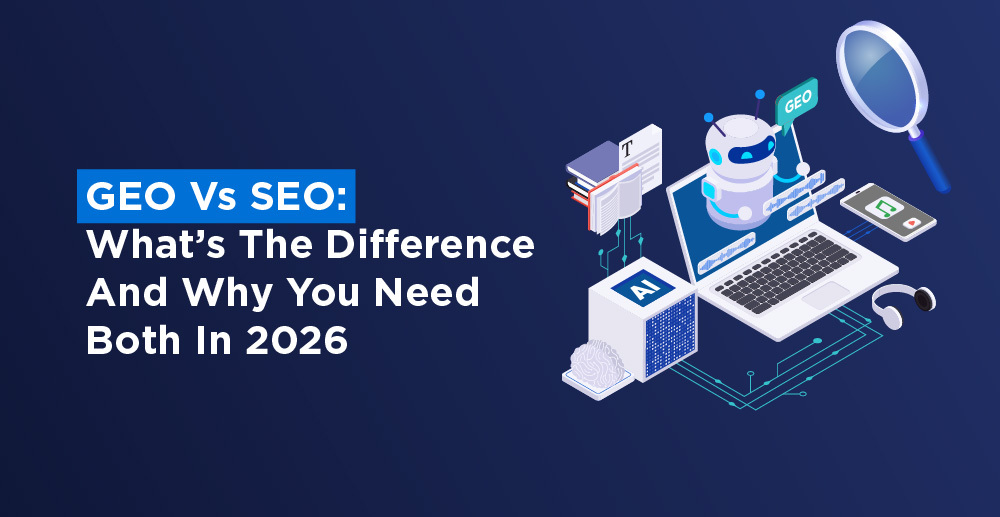
There was a time when all businesses needed to do was rank on page 1 of Google and watch the enquiries roll in. Life was simpler then, but the thing is, the way people find information online has changed. SEO remains a massive part of the ranking puzzle (most definitely!), but in 2026, a new concept has presented itself at the table.
Talking about generative engine optimisation or GEO. It’s actually been around as a defined marketing term as early as 2023, but its significance is expected to be felt more in the years ahead. In other words, it isn’t just about being a blue link on a screen these days. You should strive to be a brand that AI actually talks about.
Success today requires a two-pronged approach. You still need SEO to climb the traditional rankings, but you also need GEO to ensure your business is cited, summarised, and recommended by AI systems. Let’s dig a little deeper.
What Is SEO (Search Engine Optimisation)?
SEO is the art of making sure search engines like Google can find, understand, and rank your website. It has been the foundation of online visibility for more than 20 years. When people talk about SEO, they’re usually focusing on four main pillars:
- Technical SEO – Making sure your site loads fast and is easy for bots to crawl.
- Content – Writing helpful articles that answer specific search queries.
- Backlinks – Earning digital ‘votes of confidence’ from other reputable websites.
- User Experience – Ensuring visitors have a smooth, logical journey once they land on your page.
The goal is straightforward, and it’s something businesses are familiar with: secure a high spot in organic search results to drive qualified traffic back to your site.
What Is GEO (Generative Engine Optimisation)?
GEO is the process of optimising your brand and content so AI platforms can understand, trust, and reference your business in generated answers. It’s pretty much like the ‘digital PR’ side of search in that sense.
When someone asks an AI assistant for the best boutique hotel in Melbourne or a reliable plumber in Sydney, GEO is what helps your business become the suggested answer. This goes beyond just keywords. GEO focuses on brand authority, structured data, and topical depth.
By providing clear, fact-based info that AI models can easily digest and relay to users, you increase your chances of appearing in AI Overviews, ChatGPT-style responses, and voice assistant results.
GEO vs SEO: The Core Differences
While they share a similar goal of getting your brand noticed, the mechanics of SEO and GEO differ significantly.
| Feature | SEO (Search Engine Optimisation) | GEO (Generative Engine Optimisation) |
| Primary Goal | Ranks web pages in search results | Gets your brand mentioned in AI answers |
| User Action | Click-based traffic model | Visibility and authority model |
| Optimisation Focus | Focuses on keywords and site structure | Focuses on topics, entities, and trust signals |
| Success Metric | Measured by rankings and organic traffic | Measured by mentions, citations, and AI visibility |
Why SEO Alone Isn’t Enough in 2026
Relying solely on traditional SEO in 2026 is like trying to navigate a new city with an old paper map. AI Overviews now sit at the top of many search results, often answering a user’s question before they even have a chance to click a link.
What do these ‘zero-click’ searches mean? If your business isn’t mentioned within that AI summary, you’re effectively invisible to a large portion of your market.
Consider a local landscaping business. A customer might ask an AI, ‘Who can help me design a native Australian garden in Perth?’ If that business has great SEO but hasn’t optimised for AI recognition, the AI might recommend three competitors instead. You see, building a presence where the answers are actually being given is now a non-negotiable for growth.
How to Do SEO and GEO: Making Them Work Together
As you may have noticed, GEO isn’t about to replace SEO. In fact, these two strategies work together. Your business needs a strong SEO foundation, because it’s exactly what fuels successful GEO. You may have an AI-first web design, but AI models often pull their information from high-ranking, authoritative websites.
When you produce quality content and earn strong backlinks (SEO), you’re providing the evidence AI needs to trust your brand (GEO). It’s an integrated strategy where SEO handles the ‘where’ you rank and GEO handles ‘how’ you’re talked about. Together, they create a dominant digital presence that covers every way a customer might search.
Practical Steps to Implement GEO in 2026
Ready to move the needle? Here are a few ways to sharpen your AI visibility:
- Build deep topical authority – Move away from thin, short blog posts. Instead, create comprehensive guides that cover a subject from every angle.
- Use structured data and schema – Use backend code to tell search engines exactly what your data means (i.e., prices, locations, and reviews).
- Strengthen brand mentions – Aim to get mentioned on trusted Australian news sites, industry directories, and niche forums.
- Publish expert-led content – When creating content, focus on ‘first-hand experience’ that AI can’t easily replicate.
- Optimise FAQs – Create clear, direct answer-style sections on your pages to make it easy for AI to ‘clip’ your information.
Successful GEO and SEO: Real-World Example
What does SEO and GEO success look like? Let’s say a service-based firm in the legal sector recently shifted their focus to this dual approach. They refined their structured data and published deep-dive articles on complex Australian regulations. Then, they saw a shift.
Within months, the firm wasn’t just ranking for keywords; it was being cited as the ‘source’ in AI-generated legal summaries. This led to a surge in brand trust and high-quality leads, as potential clients saw them as the vetted experts recommended by the tech they use every day.
SEO and GEO: Transforming Your Rankings and AI Visibility
Digital marketing is no longer a one-way street. SEO builds your rankings, while GEO builds your AI visibility. In 2026 and beyond, businesses that combine both will dominate digital discovery and stay ahead of the curve.
Book a strategy session with Design Point Digital to future-proof your visibility across both Google and AI search platforms.
